Find the right one for snacking, baking and more.
Browse varietiesNot sure which apple to buy? Find the right one for snacking, baking and more.
Browse varietiesDwarf vs Semi-Dwarf vs Standard Apple Trees
How rootstocks set the height, spacing and first harvest of your apple tree
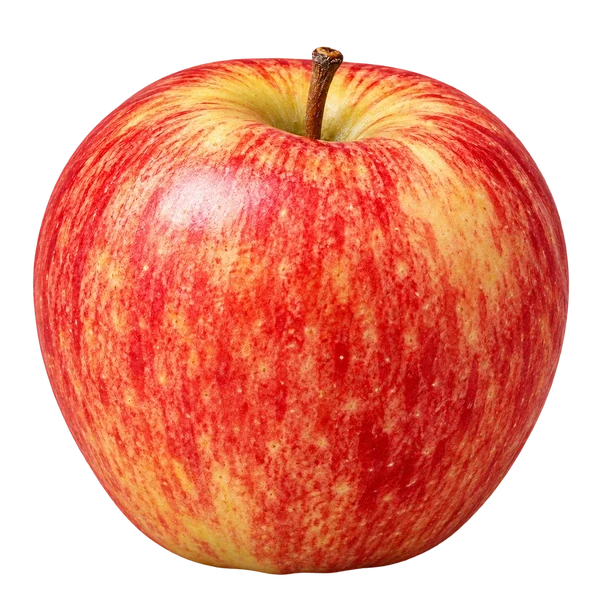
When a nursery sells a dwarf Honeycrisp or a semi-dwarf Gala, the variety name tells you about the apples. The size label tells you about the roots. Nearly all apple trees are grafted: the fruiting variety is joined to a separate rootstock, and as Ohio State University Extension puts it, the rootstock is what determines the tree size.
That choice affects far more than height. It sets how close you can plant, whether the tree needs a stake for life, how many years you wait for apples and how much fruit you'll pick. Here's how the three sizes compare, with numbers from university extension guides.
The University of Minnesota's fruit program defines the classes by percent of a full size tree: dwarf trees are about 15 to 45 percent of standard size, semi-dwarf trees about 50 to 75 percent, and standard trees more than 85 percent. Heights vary with the variety, soil and pruning, so the extension figures below overlap a bit.
Sources also differ on spacing, partly because some assume you'll prune hard and some don't. Treat the ranges as a starting point and give a tree at least as much room across as you expect it to grow tall, which is the University of Minnesota's rule of thumb.
| Dwarf | Semi-dwarf | Standard | |
|---|---|---|---|
| Typical height | About 8 to 10 feet | About 12 to 18 feet | 20 feet or more |
| Spacing between trees | 6 to 12 feet | 10 to 18 feet | 18 to 30 feet |
| Years to first crop | 2 to 3 | 4 to 6 | 6 to 10 |
| Yield per mature tree | About 2 bushels | About 4 bushels | About 8 to 10 bushels |
| Support needed | Usually, often for life | Sometimes, early years | No |
Dwarf trees are the easiest to prune, spray and pick without a tall ladder, and they bear soonest. Virginia Cooperative Extension says trees on M.9 often produce crops in two to three years, and the University of Minnesota says dwarf trees can bear two to three years after planting. UMass Extension, writing about home trellis plantings on M.9 or B.9, says trees can bear a few fruit in the second year and reach near full production within four years.
The tradeoff is a small, brittle root system. Virginia Cooperative Extension says M.9 trees must have mechanical support, and the University of Minnesota says M.9 needs staking for life. A post, a trellis or a sturdy stake is part of the purchase. Dwarf trees also produce less fruit per tree, so plan on more trees if you want a big harvest. Texas A&M also notes that the most dwarfing rootstocks have shallow roots, so steady watering and a weed free circle around the trunk matter more.
One more caution from UC's California home orchard guide: it does not favor dwarf trees over standard or semi-dwarf ones because fruit quality is generally poorer, and it notes that larger trees can be kept small with pruning. Most eastern and midwestern extension guides are more positive about dwarfs, so this is a real difference of opinion.
Semi-dwarf trees are what many home gardeners buy. They're large enough to stand on their own in most soils, small enough to manage with a short ladder, and they start bearing in about four to six years according to Virginia Cooperative Extension. MM.111, a common semi-dwarf rootstock, makes a tree about 14 to 18 feet tall in Minnesota and 16 to 18 feet in Virginia, and both extension services say it does not need support.
M.7 is a bit smaller. Virginia Cooperative Extension says most varieties on M.7 need support for the first few years, and New Mexico State University notes that M.7 is notorious for root suckers. MM.106 is a productive semi-dwarf stock, but Texas A&M advises avoiding it because of collar rot, especially in poorly drained soil.
Standard trees grow on seedling rootstocks and are not size controlled. The University of Minnesota says an unpruned seedling tree could reach 30 to 40 feet tall with a similar spread, and Iowa State puts them at 25 to 30 feet tall and wide. They take the longest to bear: 6 to 10 years in Virginia's table, and up to 8 years per the University of Minnesota.
In return they produce the most fruit per tree and live longest, 35 to 45 years versus 30 to 35 for smaller trees in Virginia's estimates. Virginia's table puts a mature standard tree at about 8 bushels a year, and the University of Minnesota says up to 10. They make sense if you have the space, don't mind a tall ladder and want a shade tree that also bears apples.
Good nurseries list the rootstock on the label or in the catalog. If they don't, ask. The figures below are rough and differ a little between sources, since growing conditions and the variety on top both change the final size.
Spur type strains add another layer. A spur strain bears on short fruiting spurs along the limbs and makes a more compact tree. A Cornell bulletin put spur types at usually about two thirds the size of their parent variety, and Texas A&M notes that spur trees come into production earlier than non-spur trees. A spur Golden Delicious or Red Delicious on a semi-dwarf rootstock can end up close to dwarf size.
| Rootstock | Class | Approx. size vs. seedling | Notes |
|---|---|---|---|
| B.9 | Dwarf | Smaller than M.9 | Cold hardy, needs support |
| M.9 | Dwarf | About 40 to 50% | Needs support for life, bears very early |
| G.41 | Dwarf | Similar to M.9 | Fire blight resistant, few suckers |
| M.26 | Dwarf to semi-dwarf | About 40 to 60% | Usually staked, prone to fire blight and collar rot |
| G.935 | Dwarf to semi-dwarf | Slightly larger than M.26 | Fire blight and crown rot resistant |
| M.7 | Semi-dwarf | About 50 to 80% | Support early on, suckers a lot |
| MM.106 | Semi-dwarf | About 60 to 70% | Collar rot in wet soil |
| MM.111 | Semi-dwarf | About 75 to 90% | Freestanding, drought tolerant |
| Seedling | Standard | 100% | Slowest to bear, longest lived |
Pick dwarf if your space is tight, you want apples soon and you don't mind setting a post or trellis. Pick semi-dwarf if you want a freestanding tree with a good crop and a reasonable wait. Pick standard if you have plenty of room and patience, or you're planting a tree for the next generation.
Whatever you choose, plant it at the right depth. The University of Minnesota warns that if the graft union ends up at or below the soil line, the variety can grow its own roots, and the tree becomes full size and slower to fruit. Our guide on how to plant an apple tree covers this step, and when apple trees bear fruit explains the other factors that affect your first harvest.
Usually about 12 to 18 feet, depending on the rootstock, variety and soil. Trees on MM.111 reach about 14 to 18 feet according to the Universities of Minnesota and Virginia Tech, and pruning can keep them smaller.
Most do. Trees on M.9 and B.9 have weak, brittle roots and need a stake, post or trellis for their whole lives. Trees on M.26 are usually staked too.
Dwarf trees. Extension guides put them at about two to three years after planting, compared with four to six for semi-dwarf and six to ten for standard trees.
No. The variety on top is the same. A dwarf Honeycrisp grows the same apples as a standard Honeycrisp. Only the rootstock underneath is different.
Best Apple Trees for Your Backyard
The best backyard apple trees are ones you can actually buy, that suit your winters, and that you can keep healthy without an orchard sprayer.
Apple Tree Pollination: Which Apples Need a Partner?
Nearly every apple tree needs pollen from a different variety that blooms at the same time. Here's how to pick partners, including triploids.
Best Apples for Baking
Which apples hold up in pies, crisps and tarts.